
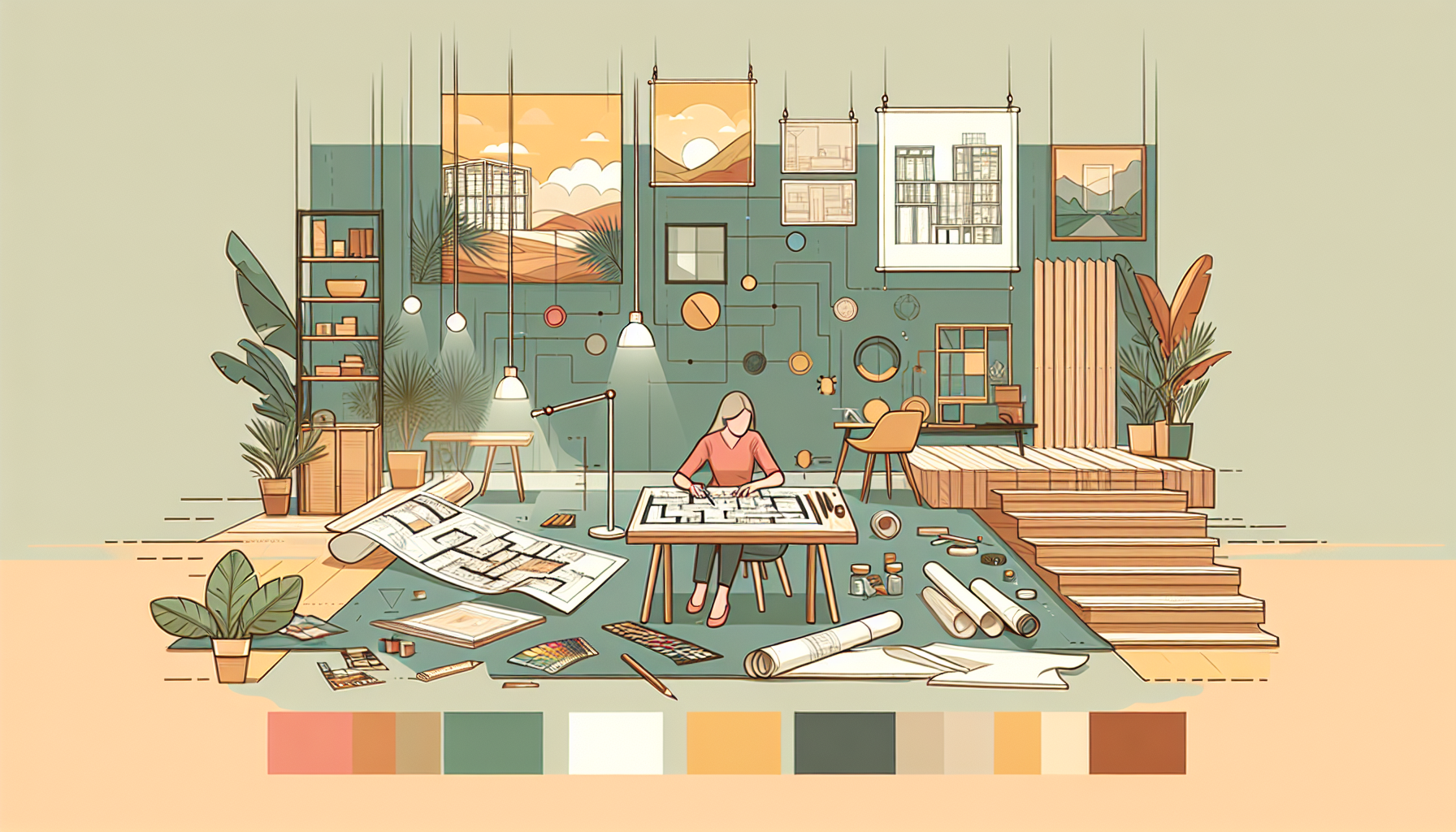
If you’re starting a career, or looking for a new one to move into, an interior design career is one of the most exciting and unique roles you could choose. An interior designer has a creative and dynamic role, involving the creation, renovation and decoration of a variety of spaces. This includes blending the functional, integrating safety and creating a space that is aesthetically stunning. An interior designer does this by determining space requirements and selecting perfect colour schemes, beautiful decorative items, unique lighting, and a variety of complimentary materials, to bring together a gorgeous and seamless design. Interior designers tend to work a typical 40 hours per week, and their earnings range from £18,000 to £45,000 depending on experience. There are a number of ways you can begin your interior designer career, including: A university course, A college program, An apprenticeship
Interior Design Education
To become an interior designer, you first need to gain the necessary qualifications and there are a number of different ways you can do this.
The first route of interior design education you can take is through a university course. You can take a foundation degree, a national higher diploma, or a degree in a relevant subject, such as: Interior design, Art and design, Interior architecture, Spatial design
To take this route, you will need to have some entry requirements. For example, you’ll need one or two A levels (or equivalent) if you want to complete a higher national diploma or a foundation degree. Or, you’ll need two or three A levels (or equivalent) for a degree.
The second route to gaining an interior design education is through a college program, here are some examples of starting point courses you can take: Level 3 diploma in interior design, Level 3 diploma in art and design, A level in art and design
To begin one of these college courses you need to meet the entry requirements, therefore you will need 4 or 5 GCSEs at a grades 9 to 4 (A* to C), or an equivalent, and this must include the subjects English, maths and a creative subject.
Formal education aren’t the only routes you can take to begin an interior design career, there are more practical routes such as design apprenticeships that can help you to achieve your goals. Which route you should take depends on your personal preference. Ask yourself, do you prefer a formal, school learning environment? Or do you find you learn better through practical work?
 Design Apprenticeships
An alternative to attending college or university is to secure one of the design apprenticeships available, for example, a furniture design technician level 3 apprenticeship is perfect for anyone looking to begin their career and begin to create their interior design portfolio at the same time.
To get onto a furniture design technician level 3 apprenticeship you’ll need to have 5 GCSEs at grades 9 to 4 (A* to C), or equivalent, and this must include the subjects English and maths. As well as these prerequisites, you’ll also need:
Some design skills and knowledge
The ability to pay attention to detail
An innovative mind that is able to create new ways of doing things
The ability to take criticism and use this to improve your own skillset
Work well under pressure
Have a strong initiative
The ability to work as part of a team
Be confident in using computers and main software packages
In design apprenticeships you will be working from various locations, including your own home, an office, in a studio and at a client’s business/premises. Your role in a design apprenticeship will include:
Meeting clients to discuss their requirements
Developing designs that suit the requirements, budget and needs of a client and their building type
Preparing mood boards and sketches for a client’s approval
Providing advice on the use of space, choice of colour schemes and the selection of fittings, furniture and fabrics.
Preparing estimations and calculating costs
Creating detailed drawings based on previous sketches, usually using a computer program
Finding suppliers for floor and wall coverings, fittings, furniture and fabrics

Work Experience
Regardless of the path you choose to take, gaining work experience is a crucial part of securing an interior design career at the end of your training and education. There is a lot of competition for interior design roles, there always has been. Gaining work experience and starting to establish your own interior design portfolio could very well be the thing that gives you the edge over the other applicants and helps you to secure the role for yourself.
Gaining work experience around studying and training isn’t always easy, but it isn’t impossible either. You can do this by securing unpaid internships, junior roles or finding other similar work environments to engage in. The likelihood you will need to offer your time for free, but eventually you will see a return on this investment. The more work experience you can gain while training, the better position you will be in when it comes to applying for interior designs roles after you are fully qualified and ready to really begin your career.
 Building a Portfolio
As well the work experience you have gained, another thing prospective employers are going to be interested in seeing is your interior design portfolio. An interior design portfolio showcases your work, your vision, your previous creations, it shows off your wide skillset, your experience and the knowledge you have in the field. In fact, some might say your interior design portfolio says more about you to prospective employers than your resume does.
You can begin to create your own portfolio by gaining experiences, and/or by completing an apprenticeship. To create a professional interior design portfolio you should:
Think about presentation: some people will choose to create a printed portfolio that they can carry with them, others might choose to create an online portfolio. There are pros and cons to both and neither is better than the other. Whichever type of portfolio you choose to create, you should make sure it looks professional. Make sure the prospective employers can see you work in its entirety, clearly. This means including photos that are sharp in resolution and optimised in terms of brightness and contrast. The same applies for any sketches and preliminary work you include.
Be concise and make a deliberate impression: Although you need to include a few things in your portfolio, you should try to be concise. Too much information and you run the risk of the prospective employer losing interest. Everything you include should serve a purpose, it should make a deliberate and strong impression.
Tell a story: your portfolio should tell the story of every design project you’ve been included in, this will help to keep the interest of the person looking at the portfolio and help them to work their way through the entire portfolio.
What should you include in your interior design portfolio?
Photographs of the finished design
Sketches and preliminary work that went into the design
Written notes about what went into the design development process
Comments on how you worked with a team to create the design
A note on your specific responsibilities in the design process
Written notes on the technology you used to create the design, including software
Comments on the technical skills you acquired during the design process
 Specialisation and Niche
Interior designers tend to work within their specialisation or niche. It is important that you define what specialisation you would like to dedicate yourself to. There are dozens of interior design specialisations to explore, including (but not limited to):
Residential: this is the specialisation most interior designers will begin their career in. This includes houses and apartments and can involve the interior design of the entire property, or just one room.
Commercial interior design: i.e. designing and building so that the interior reflects the company brand and meets the needs of the business. This includes all business, such as restaurants, airports, movie theatres, salons, shops, hotels and even gyms.
Set design: i.e. designing the set for television shows, movies and theatre productions.
Lighting design: this specialisation focuses on the area of lighting and requires designers to be knowledgeable in physics, optics, lighting equipment, colour theory, building codes, and technology, among others.
Sustainable design: designers focused on developing eco-friendly spaces.
Professional Development
Interior design is always changing and evolving, so it is importance to focus on continuous learning and staying updated with industry trends and materials, otherwise you risk your designs becoming outdated.
Conclusion
Becoming an interior designer is an exciting journey which you can achieve through education, training, apprenticeships and work experience. Pursue your passion in the field, put this into your work and create a portfolio and resume that will make it difficult for any prospective employer to turn you away.
Feel free to browse our blog for more information and don’t forget to browse our wide range of fireplaces, gas fires and stoves. You can also visit our Birmingham showroom.